Shuffle Casino Plinko
Quick answer
In Shuffle Plinko you drop a ball through a pyramid of pegs and win the multiplier of the slot it lands in. You choose 8 to 16 rows and a low, medium or high risk level: more rows and higher risk mean bigger edge multipliers but more frequent small payouts.
Plinko is one of the best-known games on Shuffle and one of the simplest: you drop a ball, it bounces through a pyramid of pegs, and you win the multiplier of the slot where it lands. Behind that simplicity are settings that completely change how the game pays. This guide explains how Shuffle Plinko works, how to get started and which settings fit your playing style.
What is Shuffle Plinko?
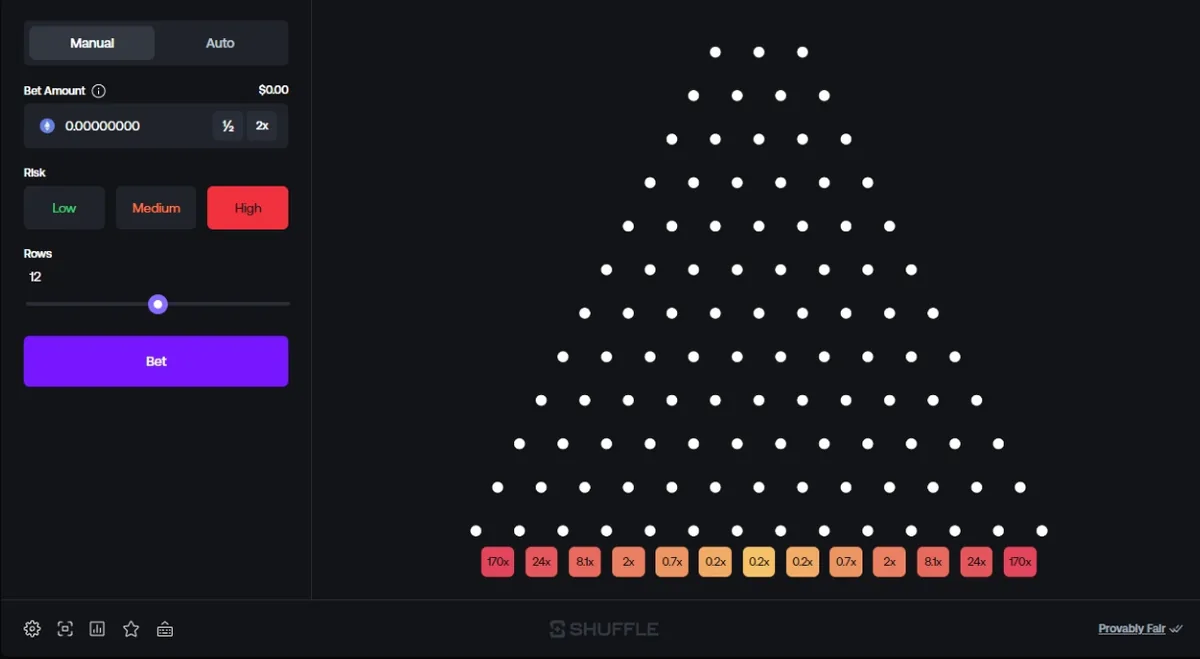
Shuffle Plinko is a provably fair Shuffle Originals game inspired by the TV game show. The board is a triangle of pegs with a row of multiplier slots at the bottom. The centre slots pay the least (often below 1x) and the edge slots pay the most. Each time the ball hits a peg it bounces left or right at random, so most balls end near the centre and only a few reach the edges.
How to start playing Plinko
- Create your Shuffle account: go to shuffle.com, accept the terms, and register with your email, username, date of birth and a password (or connect a wallet).
- Find your deposit address under Wallet > Deposit.
- Choose a coin: Shuffle accepts Bitcoin (BTC), Ethereum (ETH), Litecoin (LTC), Dogecoin (DOGE), USDC and more.
- Send funds from your exchange or wallet to that address.
- Open Plinko in the Originals section, set your bet, rows and risk level, then drop the ball (or use auto mode).
Rows and risk levels explained
Two settings control Plinko's volatility:
- Rows (8 to 16): more rows mean more bounces and more slots. With 16 rows the edge multipliers become much bigger, but landing there becomes rarer.
- Risk (low, medium, high): low risk keeps multipliers close together for steadier results; high risk lowers the centre payouts and raises the edges sharply.
| Setting | What to expect | Suits |
|---|---|---|
| 8 rows, low risk | Small, frequent swings | Long sessions, small budgets |
| 12 rows, medium risk | Balanced results | Most players |
| 16 rows, high risk | Mostly losses, rare huge hits | Jackpot hunters |
The exact multipliers for each combination are shown on the board in the game. Check them before you play.
Is Shuffle Plinko provably fair?
Yes. The path of each ball is determined by a server seed, your client seed and a nonce. You can change your client seed at any time and verify past drops in the fairness section, so neither you nor Shuffle can influence where a ball lands.
Plinko strategies for your bankroll
- Match volatility to your budget. If your balance is small, low risk and fewer rows let you play longer. High risk with 16 rows needs a bankroll that can absorb long losing streaks.
- Keep bets small relative to your balance, especially in auto mode where drops happen quickly.
- Switch settings, not stakes. If you want more excitement, raise the rows or the risk level rather than increasing your bet after losses.
- Set a stop-loss and a win goal before you start, and stop when you reach either.
The same discipline applies to the other Originals: see our guides to Mines and Blackjack.
Conclusion
Shuffle Plinko combines a simple mechanic with deep control over risk. Choose your rows and risk level carefully, verify your drops if you want peace of mind, and treat the big edge multipliers as a bonus rather than a plan.
Play Plinko on Shuffle
Create your account in under a minute and use our code when you sign up.
shuffle-bonus
Frequently asked questions
How many rows should I pick in Plinko?
More rows (up to 16) spread the multipliers further apart: the edges pay much more, the centre pays less. Fewer rows give steadier, smaller results. Pick based on how much volatility you are comfortable with.
Can you predict where the Plinko ball lands?
No. Each drop is decided by provably fair random numbers, so past drops do not influence the next one.