Shuffle Casino Crash
Quick answer
Shuffle Crash is a multiplayer Shuffle Originals game. A multiplier starts at 1.00x and rises until it crashes at a random point; you win your bet times the multiplier if you cash out before the crash. Setting an auto cash-out target is the simplest way to control risk.
Crash is one of the most popular Shuffle Originals and a favourite of crypto players because each round lasts only a few seconds and every player sees the same multiplier at the same time. This guide explains how Shuffle Crash works, how to place and cash out a bet, how to check that each round is fair, and which strategies actually help you manage risk.
What is Shuffle Crash?
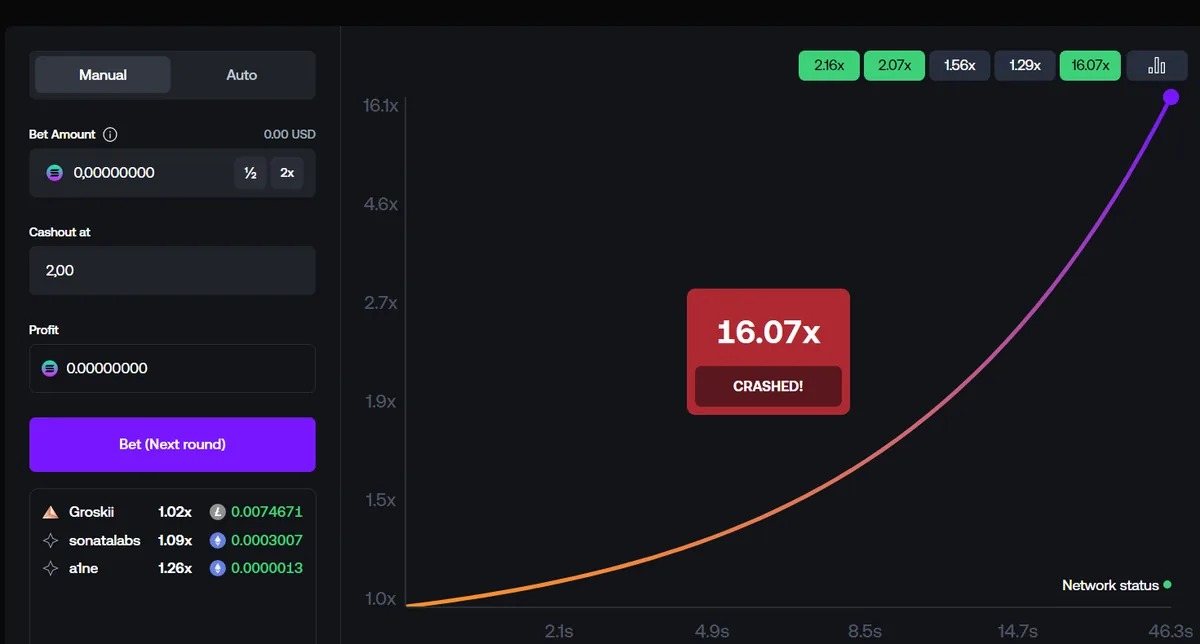
Shuffle Crash is a multiplayer multiplier game. When a round starts, a multiplier begins at 1.00x and climbs along a curve. At a random moment it crashes. Players who cashed out before the crash win their bet multiplied by the value at the moment they cashed out; anyone still in when it crashes loses their stake.
Because all players share the same round, you can see who is betting and when others cash out, which makes Crash feel closer to a live game than a solo one.
How to play Crash on Shuffle
- Open the game: log in to Shuffle and choose Crash in the Originals section.
- Deposit crypto if your balance is empty, using any supported coin.
- Set your bet amount during the short countdown between rounds, within the game's minimum and maximum limits.
- Optional: set an auto cash-out multiplier (for example 2.00x). Your bet is cashed out automatically if the multiplier reaches it.
- Watch the multiplier climb once the round starts.
- Cash out before the crash to lock in your bet × the current multiplier. If the multiplier crashes first, the bet is lost.
How payouts and odds work
Your payout is simply stake × cash-out multiplier. A $10 bet cashed out at 2.50x returns $25. The lower your target, the more often you win, but the smaller the profit:
| Cash-out target | Approximate win chance | Profit on a $10 bet |
|---|---|---|
| 1.20x | about 82% | $2 |
| 2.00x | about 49% | $10 |
| 5.00x | about 20% | $40 |
| 10.00x | about 10% | $90 |
Win chances are approximations (roughly 99% divided by the target) and include a small house edge.
Is Shuffle Crash provably fair?
Yes. The crash point of every round is generated from cryptographic seeds before the round begins. The hashed seed is shown in advance and revealed afterwards, so you can recompute the crash point yourself in the game's fairness panel and confirm it was not changed after bets were placed.
Crash strategies and tips
No strategy can beat the house edge, because every round is independent. These habits, however, help you play longer and avoid the classic mistakes:
- Set a target before you bet. Decide your cash-out multiplier in advance, or use auto cash-out, so you are not tempted to hold on "just a bit longer".
- Manage your bankroll. Set a session budget and keep each bet to a small fraction of it, for example 1–2%.
- Do not chase patterns. A run of low crashes does not make a high one more likely. Past rounds do not predict the next one.
- Beware of greed. Most losses come from waiting for a bigger multiplier than planned.
- Use two bets if you like. Some players cash out half early to cover the stake and let the other half ride to a higher target.
Conclusion
Shuffle Crash is fast, social and easy to learn: bet, watch the multiplier rise and cash out before it crashes. With a fixed cash-out target, a clear budget and provably fair rounds you can verify yourself, it is one of the most entertaining Originals on Shuffle.
Play Crash on Shuffle
Create your account in under a minute and use our code when you sign up.
shuffle-bonus
Frequently asked questions
Is Shuffle Crash rigged?
No. Crash is provably fair: the crash point of each round is derived from cryptographic seeds that are published after the round, so anyone can verify that it was fixed in advance and not changed.
What is the best cash-out multiplier in Crash?
There is no multiplier that beats the house edge. Low targets such as 1.5x–2x win more often but pay less; high targets win rarely but pay more. Choose a target that fits your budget and stick to it.